Desires and Contradictions: Exhibitions in Slovenia and Yugoslavia, 1947–1979
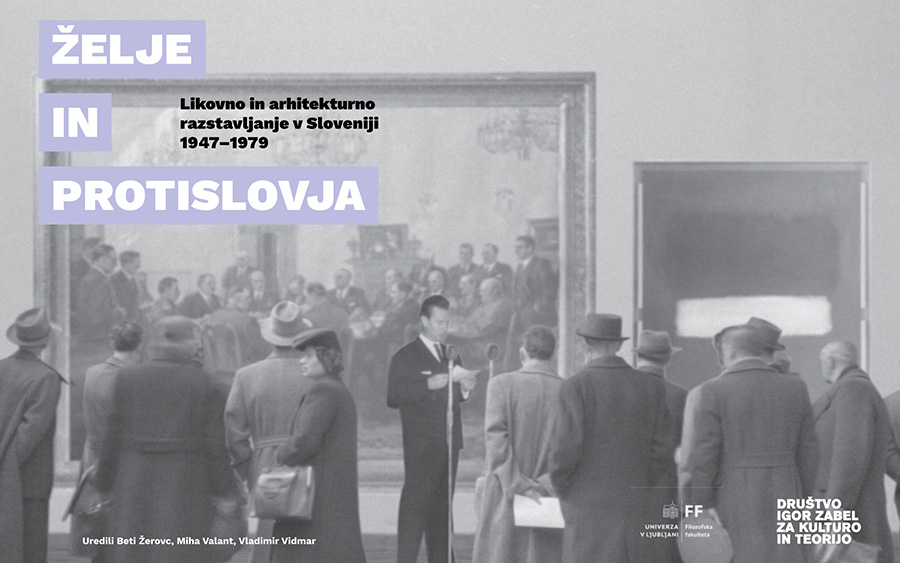
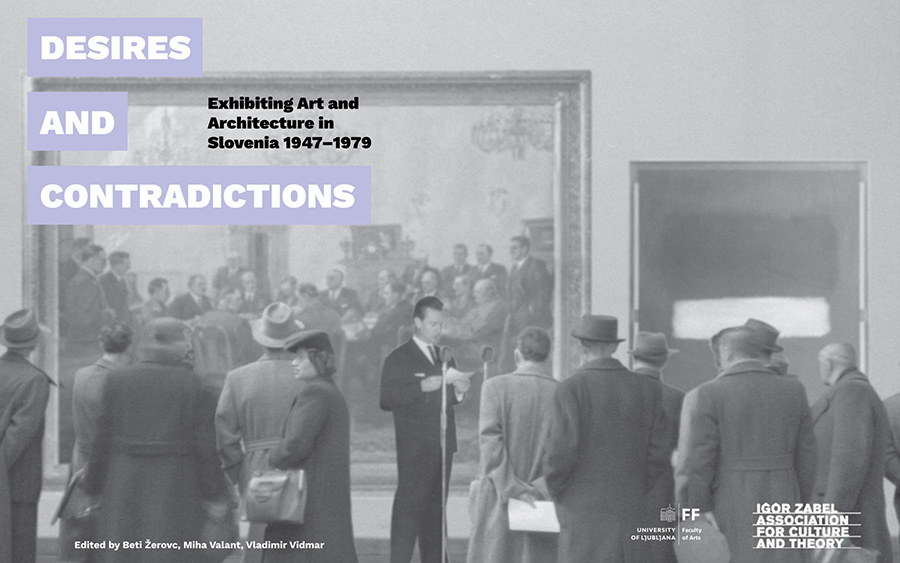
The Institute of Art History invites you to a conversation on the occasion of the monograph Desires and Contradictions: Exhibiting Art and Architecture in Slovenia 1947–1979 (eds. Beti Žerovc, Miha Valant, Vladimir Vidmar) to be held on 21 October 2026 at 7 pm in the Croatian Association of Architects (Trg bana Josipa Jelačića 3/I, Zagreb). The participants are editor Beti Žerovc and authors Gregor Dražil, Nika Grabar and Ivan Smiljanić. The conversation will be moderated by Sanja Sekelj.
The monograph examines selected examples of art and architecture exhibiting, observing them through the prism of the Yugoslav political order, its doctrine and its geopolitical prospects. Through case studies, it explores the factors that decisively shaped art and culture in relation to exhibiting, as well as how these fields operated in relation to the state: whether they adhered to and reinforced the official ideology or distanced themselves from it. The chapters consider what the exhibitions articulated and how – both in relation to the national aspirations of individual Yugoslav nations and the question of a shared cultural identity, as well as considering how they were presented internationally. Insight into the organisation of these events in Slovenia also provides a broader understanding of the exhibition as a medium and of the functioning of art institutions. In the context of the Cold War, both the exhibitions and the institutions emerge as willing collaborators with the political-economic systems and as conveyors of their ideologies – even if not necessarily those that one might have expected.
The period addressed by the monograph is framed by two exhibitions which, through their organisation, content orientation and the selection of works, tellingly reflect the historical situation of their time. The guest show Exhibition of Soviet Painters (Museum of Modern Art in Ljubljana, 1947) is representative of the brief period of the Yugoslav rapprochement to the Soviet Union in the field of art – a rapprochement that, in Slovenia, remained limited and ended in 1948 following Yugoslavia’s expulsion from the Cominform. The second exhibition, the large retrospective Slovenian Fine Arts 1945–1978 (Museum of Modern Art in Ljubljana and Architectural Museum Ljubljana, 1979), presented a broad spectrum of architecture, design and art, yet through its specific mode of presentation and interpretation, it also confirmed modernism as the most important current of Slovenian artistic production of the preceding period.
Chapter authors: Gregor Dražil, Tina Fortič Jakopič, Nika Grabar, Meta Kordiš, Katarina Mohar, Tina Palaić, Cvetka Požar, Ivan Smiljanić, Maja Vardjan, Vladimir Vidmar, Beti Žerovc
Publishers: Ljubljana University Press and Igor Zabel Association for Culture and Theory, 2026
The monograph (pdf, 139 MB) is one of the outcomes of a five-year research project. Further project results are available on the website https://razstavljanjevsloveniji.si/
Participant's biographies
Beti Žerovc, Associate Professor at the Faculty of Arts, University of Ljubljana, will, as head of the research group, briefly present the research conducted within the project Exhibiting Art and Architecture between Artistic and Ideological Concepts: The Case of Slovenia, 1947–1979 (J6-3137), funded by ARIS, the Slovenian Research and Innovation Agency.
Nika Grabar, Assistant Professor at the Faculty of Architecture, University of Ljubljana, is the author of the chapter “The Construction of the ‘Yugoslav Architecture’ Idea Through the Prism of Two Post-War Exhibitions”. She will speak about changes in architectural exhibiting before and after Yugoslavia’s expulsion from the Cominform in 1948, which led to a rapid cooling of relations with the Soviet Union.
Gregor Dražil, curator at the International Centre of Graphic Arts in Ljubljana, will speak about the connections of the Slovenian art scene with foreign countries in the field of exhibiting during the selected period. He is the author of the chapter “The Ljubljana Biennale of Graphic Arts and Exhibiting Slovenian Artists in the West: The Cases of West Germany and Italy”.
Ivan Smiljanić, Assistant with PhD at the Institute of Contemporary History in Ljubljana, is the author of the chapter “Revolution Within Frames: Artistic Creation and Exhibiting in the Yugoslav People’s Army”. He will speak about artistic creation and exhibiting in the Yugoslav People’s Army (YPA), an area in which the contradictions between the official policy of the socialisation of culture and the dominant standards of high art come to the fore.
The conversation will be moderated by Sanja Sekelj, Research Associate at the Institute of Art History.
The event is organised in partnership with the Croatian Association of Architects – UHA as part of the project “Digital Network, Spatial and (Con)textual Analysis of Artistic Phenomena and Heritage of the 20th Century – DIGitART”, funded by the European Union – NextGenerationEU, and carried out at the Institute of Art History in 2023–2027.