Right to Housing: Projects, Policies, and Knowledge Exchange after the Second World War
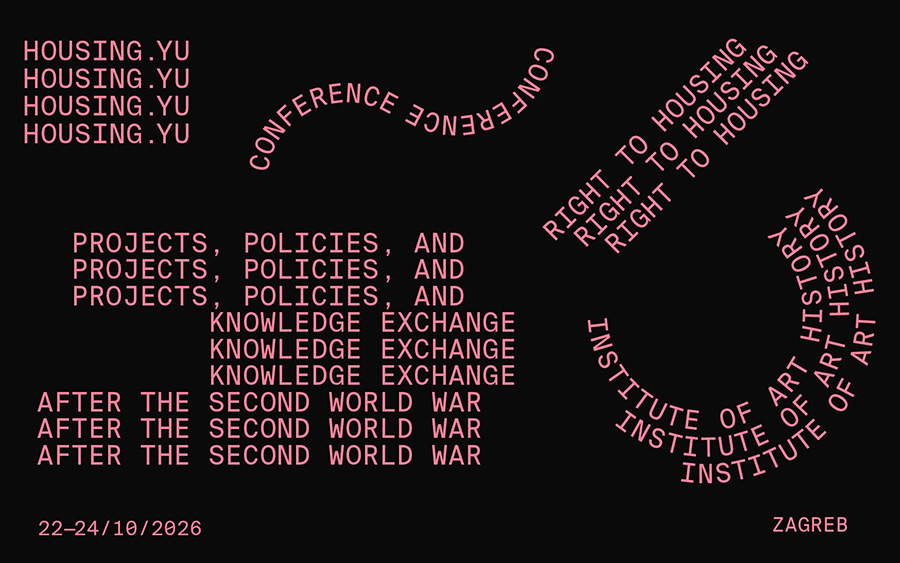
International Conference
Right to Housing: Projects, Policies, and Knowledge Exchange after the Second World War
Zagreb, October 22–24, 2026
Public Open University Zagreb
(Ulica grada Vukovara 68, ground floor)
Organizers
Institute of Art History, Zagreb
Centre for Cultural and Historical Research of Socialism, Juraj Dobrila University of Pula
In the era of rising real estate prices and rents, declining housing affordability, and increasing housing-related insecurity, the question of the right to housing is once again becoming a key social and political issue.
The international conference “Right to Housing: Projects, Policies, and Knowledge Exchange after the Second World War” will address this very issue – from historical, architectural, social, and political perspectives. It will take place from October 22 to 24, 2026, at the Small Hall of the Zagreb People's Open University (Pučko otvoreno učilište, Ulica grada Vukovara 68, ground floor).
The conference is organized within the framework of the project “HousingYu – Right to Housing: Production of Spaces of Everyday Life in Yugoslavia (1945–1991)”, funded by the European Research Council (ERC CoG – no. 101171985) and conducted at the Institute of Art History in Zagreb. The project investigates housing policies, housing finance, ownership and tenure relations, urban planning, architecture, and housing construction in socialist Yugoslavia.
The conference aims to go beyond the question of how things were built in the past. The gathering focuses on a much broader context, addressing questions such as: what did the right to housing mean as an idea or program, as a professional project, as a social right, and as a practical policy?
Throughout much of the 20th century, housing in many European countries was viewed neither exclusively as a private individual matter nor as a commodity left to the market. Instead, states, local communities, enterprises, cooperatives, architects, and urban planners developed various models aimed at systematically addressing housing shortages, rapid urbanization, and major social changes. Housing policy thus became inextricably linked to economic development, social policy, urban planning, and the organization of the construction industry.
In this context, the conference examines the political and social projects that addressed the housing issue through institutions, financing mechanisms, and the construction sector.
The historical experience is not viewed as a model that can simply be transferred to the present day. The aim is to analyze how these policies functioned, where they created new inequalities, and what lessons they offer today, at a time when the issue of affordable housing is once again at the center of public debate. The conference brings together researchers from Croatia and abroad – including the Housing.Yu project team – to discuss housing policies and social rights, mass housing construction, building systems, urban planning, everyday life, the role of tenants, the transnational transfer of knowledge, and the relationship between architecture and social change.
Plenary lectures will be delivered by Miles Glendinning of the University of Edinburgh, an internationally recognized researcher of mass housing and the preservation of 19th- and 20th-century architectural heritage, and Marija Drėmaitė of Vilnius University, a prominent architectural historian specializing in the social history of housing, architecture, and 20th-century cultural heritage in the socialist countries of Eastern Europe.
The conference aims to go beyond the confines of academic discourse and actively contribute to the public debate on housing. At a time when the role of public policy in ensuring affordable, high-quality housing is being re-examined, looking at history can help us understand how housing became a political issue and why it is difficult to reduce it solely to the real estate market.
Program Committee
Tamara Bjažić Klarin, Institute of Art History, Zagreb
Lidija Butković Mićin, University of Zadar
Marija Drėmaitė, Vilnius University
Igor Duda, Juraj Dobrila University of Pula
Miles Glendinning, The University of Edinburgh
Ljiljana Kolešnik, Institute of Art History, Zagreb
Martina Malešič, Museum of Architecture and Design, Ljubljana
Irena Šimić, Institute of Art History, Zagreb
Mejrema Zatrić Šahović, International University of Sarajevo
Organizing Committee
Hana Bečeić
Antun Dulibić
Emil Jurcan
Marija Jurić
Aida Murtić
Saša Vejzagić
Frano Petar Zovko
All members of the Organizing Committee are employed at the Institute of Art History in Zagreb.
***
The public discussion Residential Architecture in Croatia in the 1970s and 1980s is an introductory event to be held on Monday, October 19, 2026, at 6:00 PM at the DAZ/UHA premises (Trg bana J. Jelačića 3/1). Participants in the discussion include Višnja Cimić, Mladen Jošić, Đorđe Romić, Andrija Rusan, and Benedetto Tardozzi, with Tamara Bjažić Klarin, Lidija Butković Mićin, and Frano Petar Zovko serving as moderators.
More information about the project is available through the official project website.
#HousingYu #ERCCoG